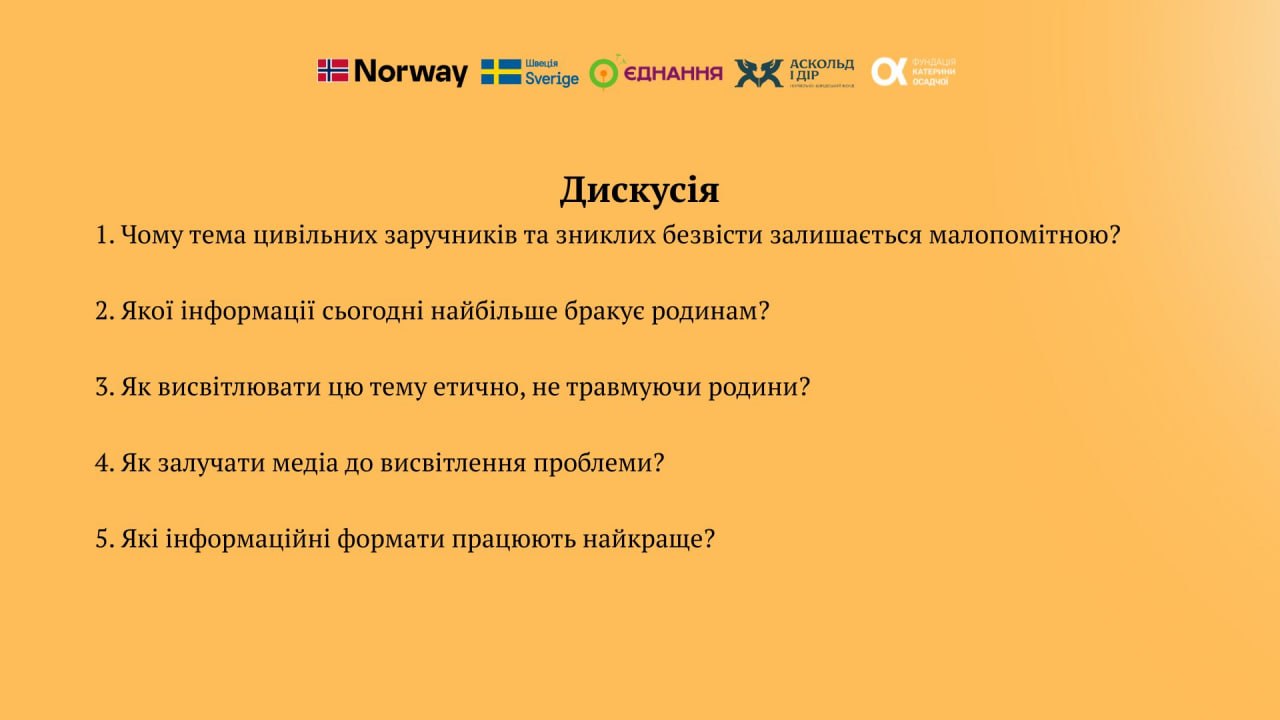
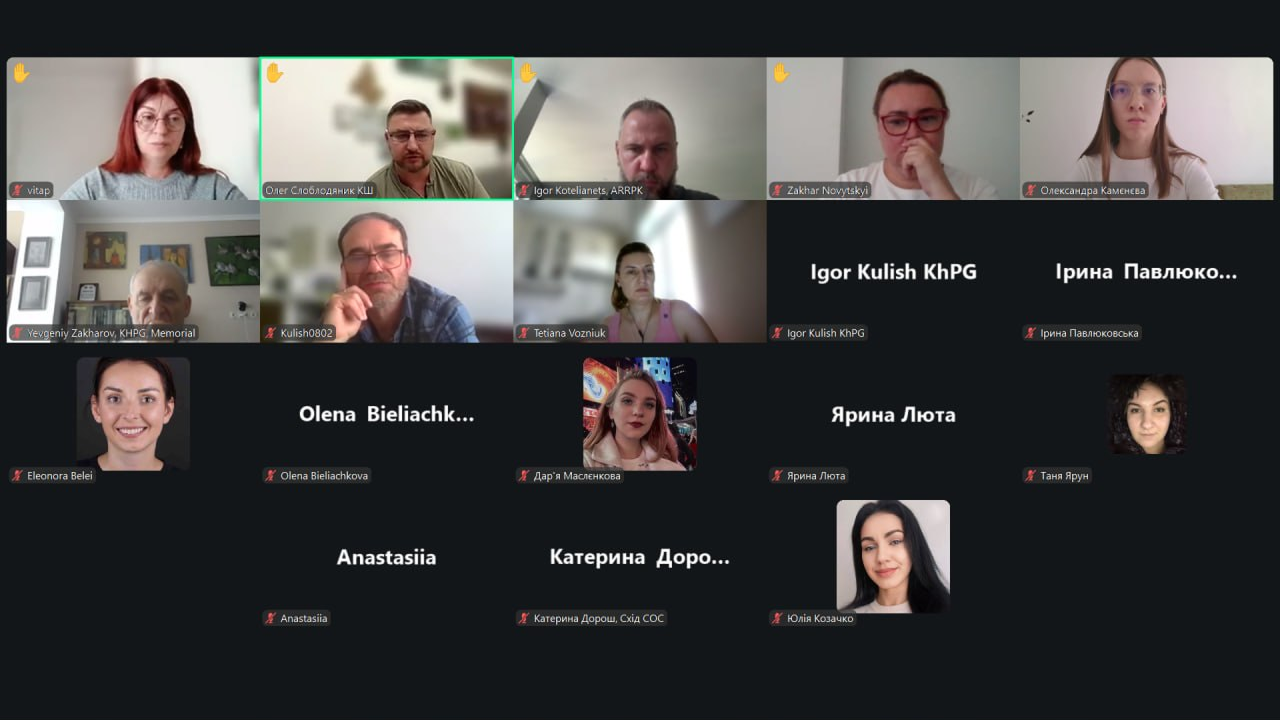
The Kateryna Osadcha Foundation, as part of its "Search for the Missing" initiative, hosted a roundtable discussion titled "How to increase the visibility of the missing persons and civilian captivity issue? Why is it important to document stories of disappearance and civilian captivity?"
The meeting brought together representatives from government agencies, NGOs, media, and the expert community to address a shared question: how to discuss missing persons and civilian hostages in a way that keeps the topic on the public and media agenda while ensuring families receive the information and support they need.
The discussion included a representative from the Coordination Headquarters for the Treatment of Prisoners of War.
A central theme of the roundtable was the lack of visibility surrounding the issue of missing persons and civilian captivity. Participants discussed how to draw attention to this topic among both Ukrainian and international audiences without reducing human stories to mere statistics or sensationalist content.
A key takeaway was the need to combine statistical data with the stories of specific individuals and their families, provided they consent. Personal narratives are what help society realize that behind every number is a real person, their family, and a long, painful wait.
At the same time, participants emphasized that the decision to publicize any individual story must be made on a case-by-case basis, with full consideration for the person's safety and the family's wishes.
The discussion highlighted that communication regarding missing persons and civilian hostages cannot be one-size-fits-all.
For Ukrainians, it is essential to provide systematic explanations of search mechanisms, step-by-step guides for families, the roles of responsible government agencies, and available support resources. For an international audience, it is necessary to provide broader context regarding life in temporarily occupied territories, the facts of illegal civilian detention, and violations of international humanitarian law.
Specific informational materials are also needed for Ukrainians living abroad who are searching for their relatives. These should contain clear action plans, contact details for authorized bodies, and up-to-date information on available assistance mechanisms.
Another key area of discussion was how to inform the families of the missing.
Participants stressed the need to systematically explain exactly where to turn for an official search and to warn against using unverified or unofficial sources of information. It is also important to clearly explain the significance of providing DNA samples for identification and search operations.
Furthermore, information must be not only accessible but also handled with sensitivity. When communicating about missing persons and civilian hostages, it is crucial to avoid sensationalism, inappropriate phrasing, and content that could re-traumatize families.
During the roundtable, participants also noted the lack of a unified standard for media coverage of missing persons and civilian hostages.
One proposal was to develop recommendations or editorial guidelines for journalists to help them cover these stories professionally, ethically, and with due regard for the safety of the victims and their families.
To simplify the process for journalists and families, it has also been proposed to create a list of government agencies and non-governmental organizations that officially work on issues related to missing persons and civilian hostages. This will make it easier to quickly find competent experts and obtain verified information.
Following the roundtable, participants developed 11 recommendations. These include supporting and consolidating communities of families of missing persons and civilian hostages, leveraging media potential to highlight individual stories while adhering to safety protocols, establishing a consistent state policy for media coverage of the issue, and fostering ongoing collaboration between government agencies, NGOs, media, international partners, and family associations.
Roundtable participants agreed that the only way to increase the visibility of the issue of missing persons and civilian captivity is through systematic cooperation. This is not about one-off information campaigns, but rather about continuous dialogue, coordination, knowledge sharing, and collaborative problem-solving.
Following the meeting, the Kateryna Osadcha Foundation summarized the proposals and prepared recommendations for future work on this issue.
The Foundation thanks all roundtable participants for their open discussion, professional insights, and concrete proposals. Combining the efforts of the state, the civil sector, the media, the expert community, and families is essential to ensuring that the voices of those waiting for their loved ones are heard.
The event was organized by the "Search for the Missing" initiative of the Kateryna Osadcha Foundation with the support of the Askold and Dir Foundation, administered by ISAR Ednannia as part of the "Strong Civil Society of Ukraine — Driver of Reforms and Democracy" project, funded by Norway and Sweden.ʼ
%20(1).png)






_page-0001%20(1).jpg)