%20(1).png)
Results of the all-Ukrainian career guidance study for teenagers and young adults*
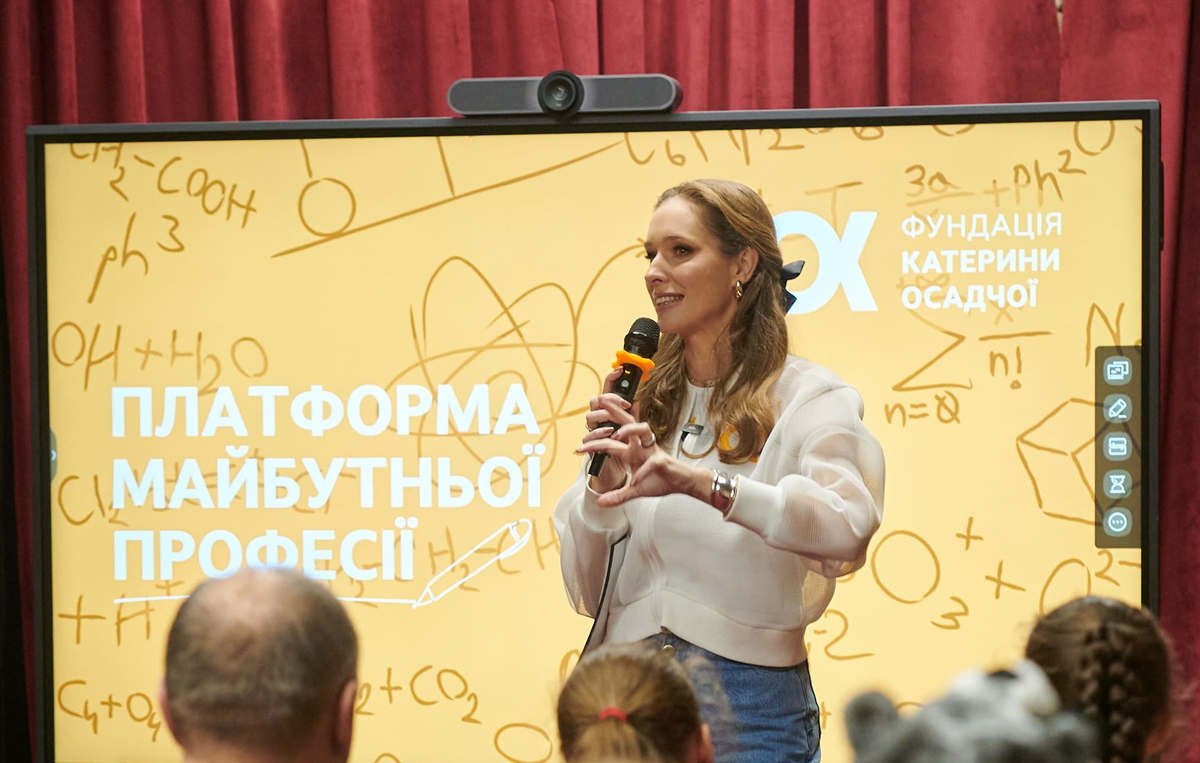
How do young Ukrainians choose their future careers? What influences this choice? Do young people understand which specialists the country needs most? These and other questions formed the basis of an all-Ukrainian study on the professional choices of young people, conducted by the Kateryna Osadcha Foundation.
The results showed that common perceptions—that young people don't know what they want to be or aren't interested in the professions Ukraine needs—are not entirely accurate. In reality, young Ukrainians are thoughtful about their future, actively seeking information, analyzing opportunities, and striving to make informed choices. At the same time, there is a noticeable gap between understanding the social importance of certain professions and the willingness to commit one's own future to them. This finding became one of the key takeaways of the study.
Today's Ukrainian teenagers are forming their career plans in a reality that is fundamentally different from the one their parents faced. War, the rapid development of artificial intelligence, fast-paced changes in the labor market, and the emergence of new specialties make career choices significantly more complex than they were even a decade ago.
Under these conditions, the traditional model of career guidance is no longer effective. While it used to be enough to choose a specialty and gradually build a career in one field, today even the "right" choice does not guarantee a stable professional future.
It is no surprise that young people increasingly view career choice not as a once-in-a-lifetime decision. Although 69% of respondents believe they have already decided on their professional direction, only 47% demonstrate a truly formed and consistent choice. The rest are still refining their plans, considering alternatives, or have yet to establish a clear career path.
As a result, professional self-determination is becoming a fluid process that evolves alongside new experiences, knowledge, and life circumstances. This is why we should move beyond talking about "career guidance" and start focusing on "career navigation."
"69% of young people believe they have already decided on their professional direction. At the same time, only 47% demonstrate a truly formed and consistent career choice."
One of the most common stereotypes is that young people don't know what they want. However, the study results suggest the opposite.
Over the past six months, nearly eight out of ten respondents have independently sought information about professions. The majority have discussed their future with parents or other adults, and nearly half have attended career guidance events, open days, or specialized courses.
In other words, young people are not waiting for someone else to make decisions for them; they are actively seeking answers on their own. Yet, this is where the biggest gap emerges. Although most have already learned about professions through lectures, videos, meetings, or consultations, only about a quarter have had the opportunity to gain real practical experience—such as completing an internship, volunteering, or at least briefly immersing themselves in a professional environment.
In effect, the current career guidance system is good at teaching young people how to gather information, but it creates almost no conditions for them to test their choices in practice.
Today, there is more information about professions than ever before. In a single evening, you can watch dozens of videos about the work of a doctor, programmer, or architect, read university curricula, find job openings, chat with professionals on social media, or even ask artificial intelligence about the prospects of a particular specialty. One might think this is enough to make an informed choice. However, the study shows otherwise.
A large volume of information does not reduce uncertainty; sometimes, it even increases it. After all, knowing about a profession and experiencing it are two very different things. That is why young people are increasingly asking themselves not "Which profession is more promising?" but rather "Is this really the right career for me?" And the answer to this question is increasingly shaping professional choices far more than the prestige of a specialty or the level of future salary.
If you ask Ukrainian teenagers to name the professions that will be critically important for the country in the coming years, the answer is quite predictable: medicine, reconstruction, engineering, energy, and transport. These are the very fields young people identify as most vital for Ukraine's future, yet this is precisely where one of the most intriguing paradoxes emerges.
Understanding which professions the country needs does not necessarily mean being ready to choose one of them for yourself.
Researchers have found the largest gap between the social importance of a profession and the willingness to pursue it in these very strategic sectors. This is most evident in construction and reconstruction, medicine and rehabilitation, energy, the agricultural sector, and transport.
These results force us to ask a completely different question. Not "Why don't young people want to work in these fields?" but "Why don't they see themselves in these professions?"
Usually, labor shortages are explained by low salaries, the difficulty of training, or a loss of professional prestige. However, research shows that this is not the whole story. For example, medicine remains one of the most respected professions. Young people recognize its social value. The same applies to engineering, reconstruction, and energy.
And yet, it is precisely regarding these professions that an internal feeling most often arises: "This isn't for me."It turns out that a psychological barrier can be stronger than economic factors. Young people do not deny the importance of strategic professions. They simply cannot imagine themselves as someone working in that specific field. This gap between social need and personal identification is becoming one of the key challenges for modern career guidance.
Research reveals another important pattern: interest in a profession does not always translate into a willingness to choose it. Broadly speaking, all professions can be divided into several groups. There are those about which a person says almost immediately: "I see myself here."Most often, these are education, psychology, and creative specialties.
There are professions that spark admiration but leave an internal distance: "This is interesting. But is it really for me?" This is the category where young people most often place IT, engineering, law, and, to some extent, medicine.
Finally, there are fields perceived as critically important for the country but rarely associated with one's own future. These are primarily energy, the agricultural sector, and specific areas of reconstruction. In reality, people do not choose the professions that seem most important; they choose the ones where they can see themselves.
Another stereotype is that today's youth change their minds easily. In fact, research shows otherwise: young people are not frivolous—they are afraid of making the wrong choice. Among the main barriers, they cite not financial difficulties or even the war, but uncertainty about their own interests and abilities. Almost one in three is afraid of choosing the wrong profession. A quarter of those surveyed admit they do not fully understand what they are truly interested in. Many are unsure of their own strengths.
In effect, young people approach career choices without an answer to a fundamental question: "Who am I?". Until there is an answer to that, even the most promising specialty remains an abstract possibility.
This is why professional self-determination is increasingly becoming a process of self-discovery rather than just choosing a university.
For many years, career guidance followed a similar script: students were told about professions, introduced to university majors, and explained which subjects they needed to take. Today, that is no longer enough. Not because young people have become less responsible, but because they are much more thoughtful about their own future.
Information is no longer the deciding factor; it has become only the first step. A real decision is born when a person has the opportunity to see a profession from the inside, talk to those working in it, understand the day-to-day reality of the job, and honestly answer for themselves: "Can I imagine myself here?".
Thus, the answer to this question increasingly determines professional choices far more strongly than university rankings or expected income levels.
When young people were asked what would help them most in making a career choice, social media and advertising campaigns were not at the top of the list. The most valuable factors turned out to be:
Despite digitalization, the generation that grew up with a smartphone in hand trusts live experience above all else. Research results confirm this: young people identify live events and personal interaction as the most effective channels for career guidance. In other words, the best career guidance isn't the one that talks the most about a profession, but the one that allows you to experience it.
At first glance, choosing a profession seems like a personal matter. However, research results show otherwise. Soon, Ukraine will enter a period of large-scale reconstruction and development of key sectors—healthcare, energy, industry, and infrastructure—all of which will require thousands of new specialists. At the same time, these are the very professions about which young people most often say: "I understand they are needed. But I don't see myself there."
Therefore, the talent shortage will increasingly depend on how well society can help young people find their place in these professions. In other words, career navigation is becoming a matter of developing the country's human capital.
"The career choices of young people today are not just a matter of individual career paths. They are a matter of the future of Ukraine's human capital."
The most important conclusion of the study is that Ukrainian youth have not lost their motivation—they are attentive to their future, strive to find their own path, and are afraid of making mistakes. That is why they need not only information about professions but also the opportunity to see them in real life, talk to experts, ask questions, and gain personal experience. The study shows that career guidance can no longer be limited to providing information: it must evolve into a system of professional navigation that helps young people not just learn about professions, but find one where they can see themselves. After all, this choice determines not only an individual's future career but also who will build, heal, teach, and rebuild Ukraine in the coming decades.
* The study covers all of Ukraine, excluding temporarily occupied territories (Donetsk and Luhansk regions and the Autonomous Republic of Crimea)






_page-0001%20(1).jpg)